
Brazuka
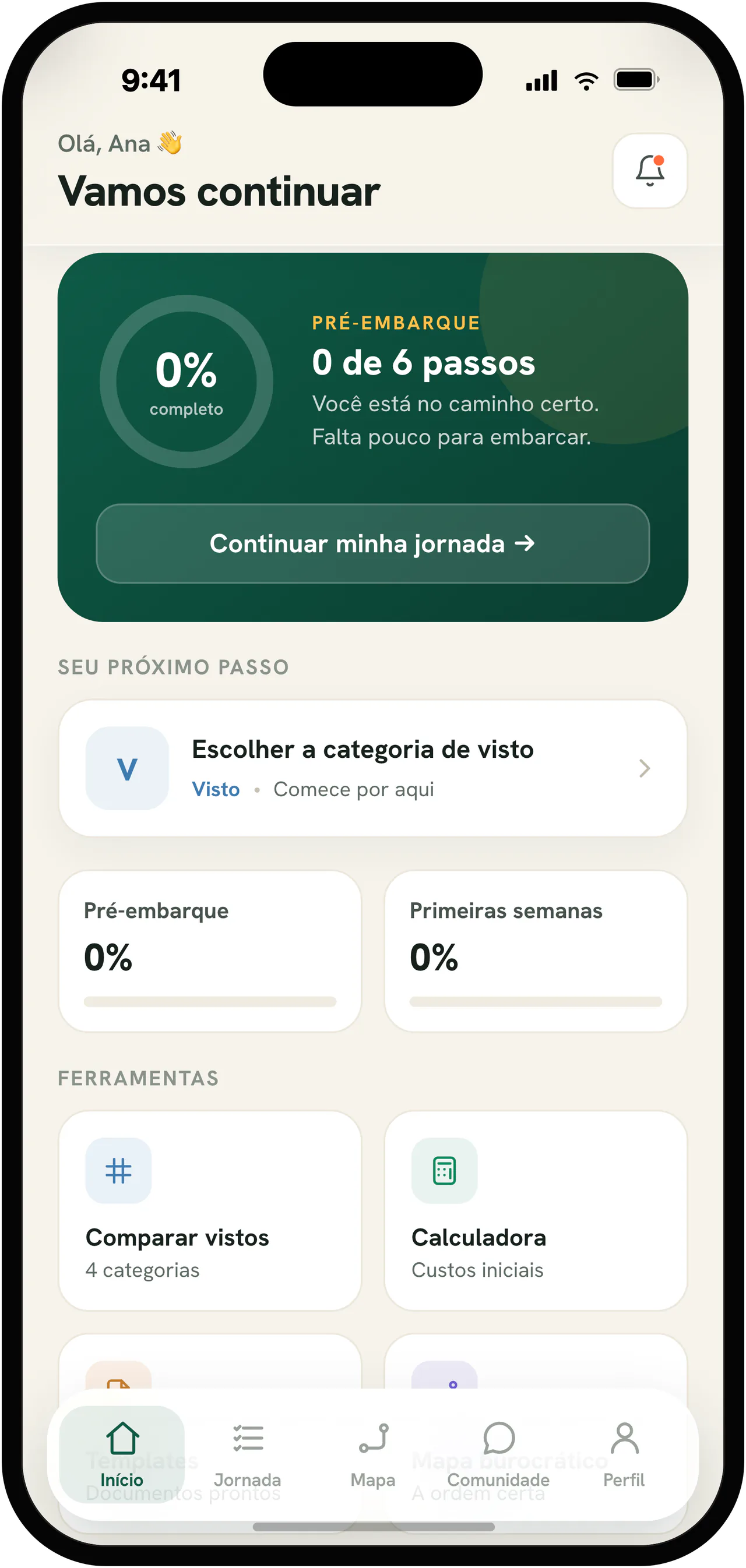
iOS · Home, Chegando, Brazuka Pro · demo data
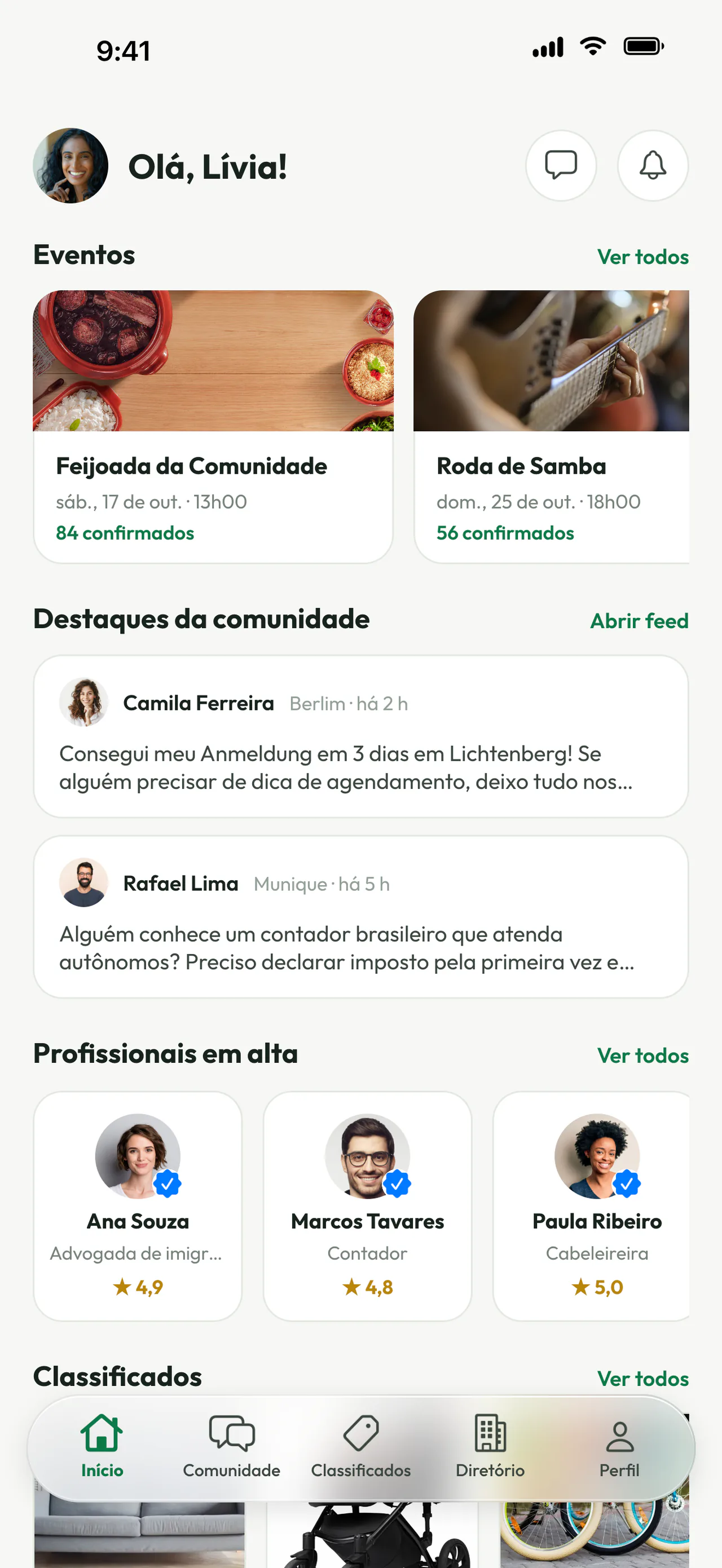
Brazuka gives Brazilians in Germany one place to find people, services and answers in their own language. It began as Re-start in Germany, a UX research project at university: a 22-person survey, a journey map and a prototype. Then I built it: native apps for iOS and Android on one Firebase backend, live on the App Store since 25 July 2026 and on Google Play since October 2026.
Part 1Research
Re-start in Germany
Before Brazuka had a name, it was a research question at university: why is starting over in Germany so hard for Brazilians? This part follows the UX process from the problem to a prototype and a business case.
University project · BA UX/UI Design, summer semester 2026 · supervised by Prof. Thomas Noller
Context
A circular trap.
Moving to Germany means rules that depend on each other. You need an address before you can register (the Anmeldung), and registration has to happen within 14 days. The bank wants the registration. Sometimes the landlord wants the bank. The answers exist, but they are spread across German portals, English-only guides and WhatsApp threads that ask the same questions every week.
Germany ranks 50th of 53 countries for expats, and 66% of expats find its authorities difficult to deal with (InterNations Expat Insider 2024). I audited the alternatives: Make it in Germany, Settle in Berlin, the Ankommen app and Portuguese blogs such as Euro Dicas. None was in Portuguese, mobile-first and step-by-step at the same time.
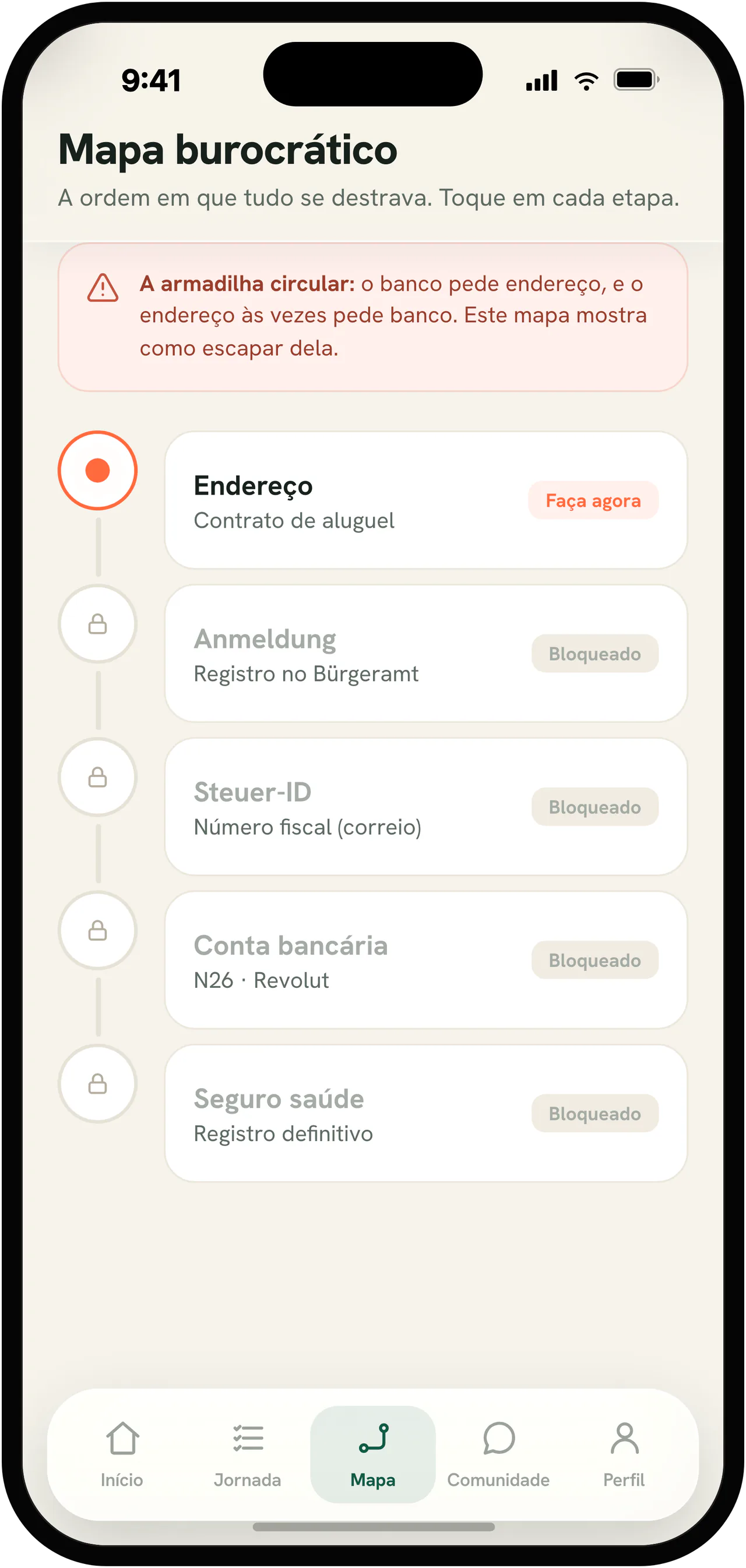
To register (the Anmeldung) you need a place to live; to open a bank account you need the Anmeldung; and some landlords want a bank account before they rent to you. The tax ID only arrives after the Anmeldung. Re-start breaks the loop by putting the steps in one order and unlocking each one when the step before it is done.
Address
the landlord may want a bank account
Anmeldung
needs an address, within 14 days
Tax ID
arrives after the Anmeldung
Bank account
needs the Anmeldung
Re-start’s bureaucracy map: one step at a time
- AddressEndereço, open
- Anmeldung, locked until the step before is done
- Tax IDSteuer-ID, locked until the step before is done
- Bank accountConta bancária, locked until the step before is done
- Health insuranceSeguro saúde, locked until the step before is done
Research
Twenty-two answers, one clear pain.
I combined desk research (community data, Destatis, InterNations, search trends and the groups where Brazilians in Germany talk) with a bilingual survey of 11 questions. It went out on 26–27 April 2026 in the WhatsApp and Facebook groups where people already find each other. The April study used the first 20 responses; the form stayed open and reached 22, and every number on this page uses all 22.
Who answered shapes what the answers mean: 21 of 22 respondents have lived in Germany for more than a year, and nobody was still planning or in the middle of a move. These are recollections of the move, not live experience.
Paperwork was the pain. Documents and bureaucracy were the most stressful part, ahead of housing and language, and nobody picked visa type or health insurance. For answers, people went to Google and to friends already in Germany before official sites.
- Documents & bureaucracy: most stressful
- 41%
- Looked on Google
- 77%
- Asked friends in Germany
- 73%
- Open to paying (stated)
- 68%
Share of all 22 survey respondents
| Answer | People | Share |
|---|---|---|
| Living in Germany for more than a year | 21 | 95% |
| Living in Germany for less than a year | 1 | 5% |
| Still in Brazil, planning to go | 0 | 0% |
| In the middle of moving (visas, documents) | 0 | 0% |
| Gave up and went back to Brazil | 0 | 0% |
Nobody was still planning, in the middle of a move, or back in Brazil.
| Answer | People | Share |
|---|---|---|
| Documents and bureaucracy | 9 | 41% |
| Housing | 7 | 32% |
| Cultural adaptation and language | 4 | 18% |
| Anmeldung (city registration) | 1 | 5% |
| Bank account | 1 | 5% |
| Visa type | 0 | 0% |
| Health insurance | 0 | 0% |
| Other | 0 | 0% |
One answer each. Shares are rounded.
Chosen by nobody: visa type, health insurance and other.
| Answer | People | Share |
|---|---|---|
| Google / internet | 17 | 77% |
| Friends already living in Germany | 16 | 73% |
| Official sites (Make it in Germany, BAMF) | 12 | 55% |
| YouTube | 11 | 50% |
| Facebook and WhatsApp groups | 8 | 36% |
| Brazilian consulate or embassy | 7 | 32% |
| Instagram / TikTok | 5 | 23% |
| 2 | 9% |
Multiple choice: shares add up to more than 100%.
Survey
Too much information, not enough path.
Information wasn’t the gap. Almost half felt overwhelmed by the amount of it, only 6 of 22 found it easy to understand and follow, and half stayed neutral on that.
What people asked for was specific: explanations of the documents they need, step-by-step checklists, and a guide in their own language. A step-by-step guide in Portuguese would give 12 of 22 more confidence, and as many would trust an app made by a Brazilian who went through the move over other websites.
Money is the softest signal. Five said yes to a premium plan and ten said maybe, depending on the content. That is stated intent, not measured behavior, which is why the validation plan below puts real paid conversion first.
Two open questions asked for the biggest difficulty and the one thing people wish they had been told. Language, housing, bureaucracy and the emotional cost of the move came up most. They appear here as themes, never as quotes.
| Statement | 1 Strongly disagree | 2 Disagree | 3 Neutral | 4 Agree | 5 Strongly agree | Agree |
|---|---|---|---|---|---|---|
| I would trust an app made by a Brazilian who went through the process more than various other websites. | 1 | 3 | 6 | 4 | 8 | 55% |
| A step-by-step guide in Portuguese would give me more confidence. | 2 | 3 | 5 | 6 | 6 | 55% |
| When I researched how to move to Germany, I felt overwhelmed by the amount of information. | 2 | 5 | 5 | 3 | 7 | 45% |
| The information I found was easy to understand and follow. | 1 | 4 | 11 | 4 | 2 | 27% |
Scale: 1 strongly disagree · 3 neutral · 5 strongly agree.
Side totals: disagree (1–2) and agree (4–5), as a share of 22.
| Answer | People | Share |
|---|---|---|
| Explanations of the documents you need | 16 | 76% |
| Step-by-step checklists | 15 | 71% |
| Cost of living and money tips | 12 | 57% |
| A community of Brazilians in Germany | 10 | 48% |
| Visa and work information | 10 | 48% |
| Housing and neighborhood tips | 9 | 43% |
| Emotional support and other people’s stories | 8 | 38% |
Multiple choice: shares add up to more than 100%.
21 of 22 answered this question.
Stated, not measured: what people say, not what they pay.
Prices as the form gave them, in reais with a euro estimate.
Q4 · Open answern = 14 people answered
What was the biggest difficulty or doubt during the move?
- Language, about 5 answers
- Finding a first flat: Schufa, prices, and needing one for the Anmeldung, about 4 answers
- Bureaucracy, about 3 answers
- The emotional cost: grief, insecurity, fear of not adapting, about 3 answers
- Visa, about 1 answer
- Bank account, about 1 answer
- Wrong or misleading information online, about 1 answer
Q11 · Open answern = 13 people answered
What is one thing you wish someone had told you before moving?
- Bureaucracy has no single rule: it depends on the clerk, and Bürgeramt fees are often cash, about 3 answers
- Making friends is hard; start with fellow Brazilians, about 2 answers
- Learn much more German before you move, about 2 answers
- Realistic expectations of life as an immigrant, about 2 answers
- Practical surprises, from energy contracts to the cold, about 2 answers
- Value your professional seniority; a professional community would have helped, about 1 answer
- Laws, rights and duties, about 1 answer
Coded themes, not quotes. One answer can carry several themes, so counts are approximate (≈).
Synthesis
From answers to scope.
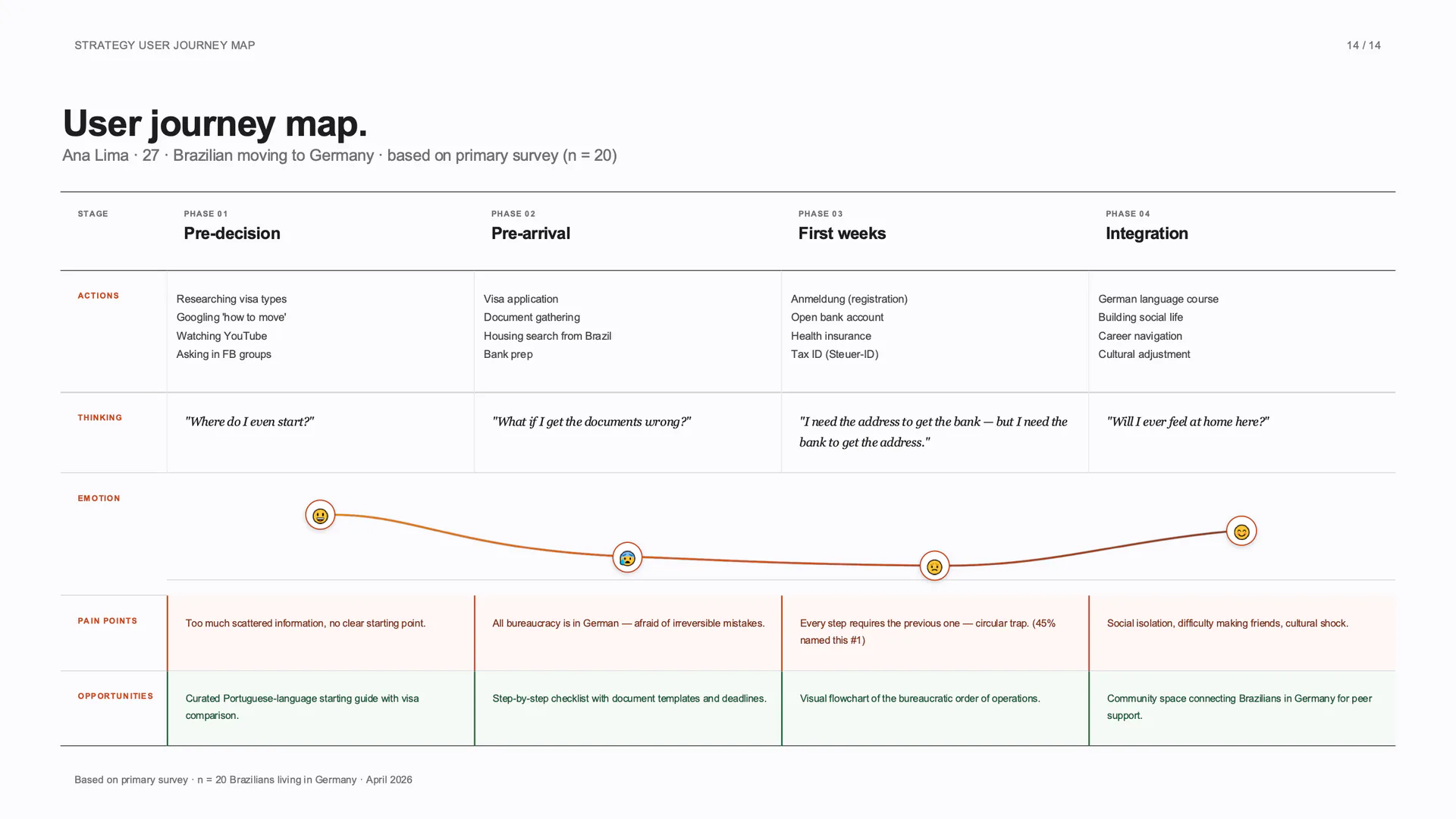
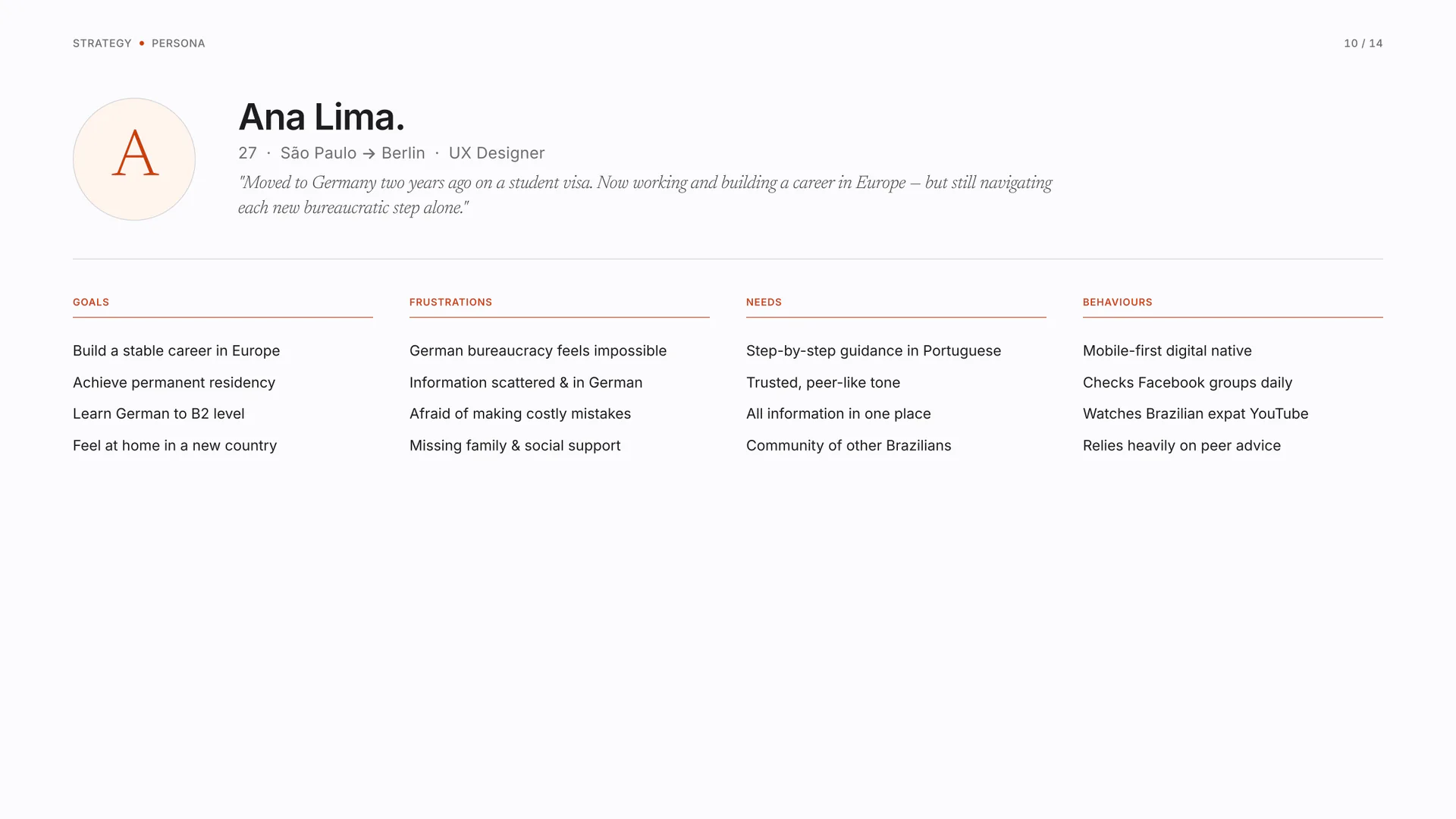
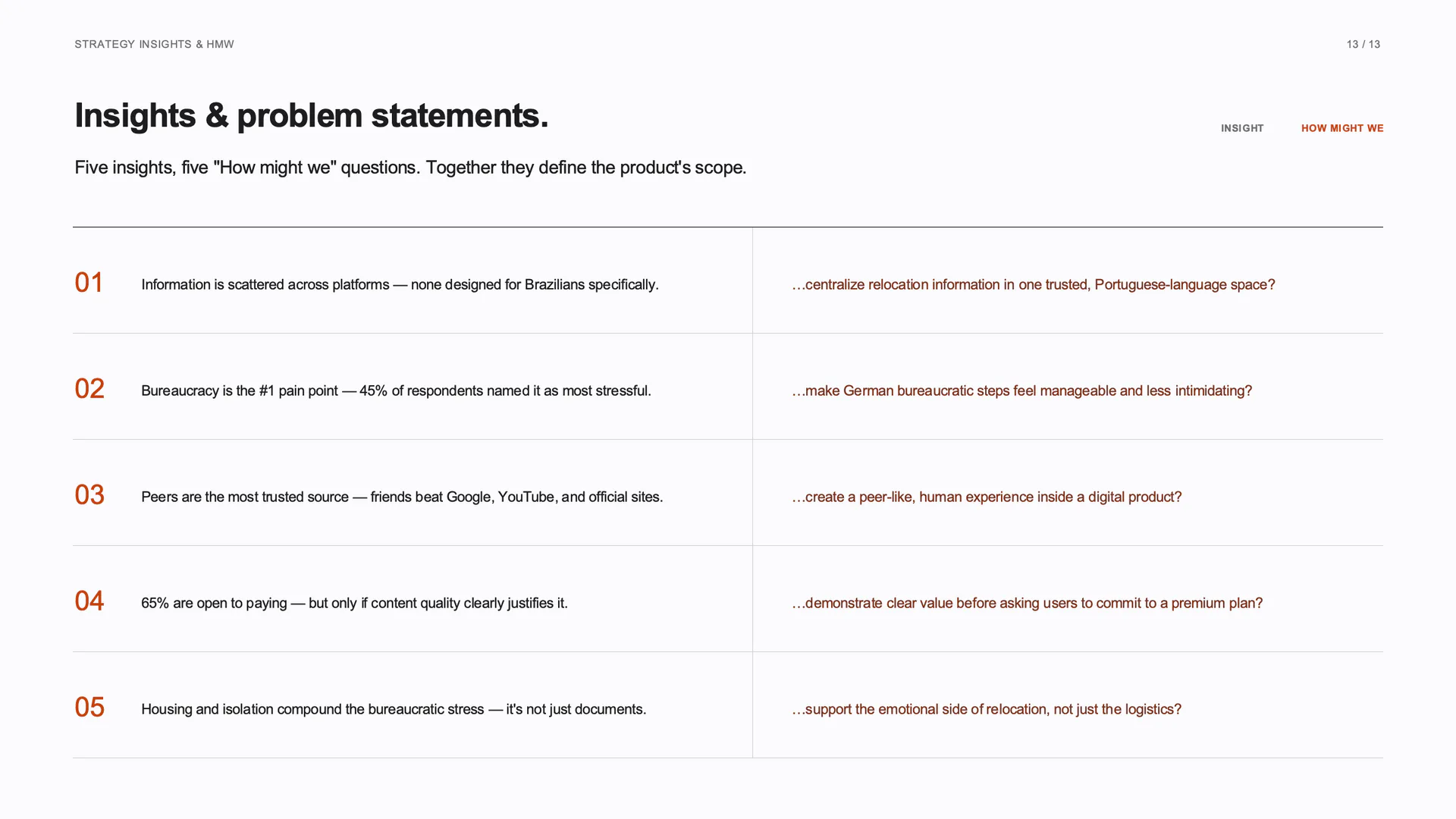
I turned the findings into a persona, an empathy map and a journey map. On the map, the emotion curve hits its lowest point in the first weeks after arrival, right where the circular trap sits. Five insights became five How-Might-We questions, and those questions set the scope.
Persona
Ana Lima, 27, moving from São Paulo to Berlin.
Empathy map
What she says, thinks, does and feels around the move.
Journey map
Four phases: pre-decision, pre-arrival, first weeks, integration.
How might we
Five insights reframed as five questions that define the product.
Prototype
Every principle traced to a number.
Each design principle is anchored to a survey result. If a feature couldn’t be traced back to the research, it was cut.
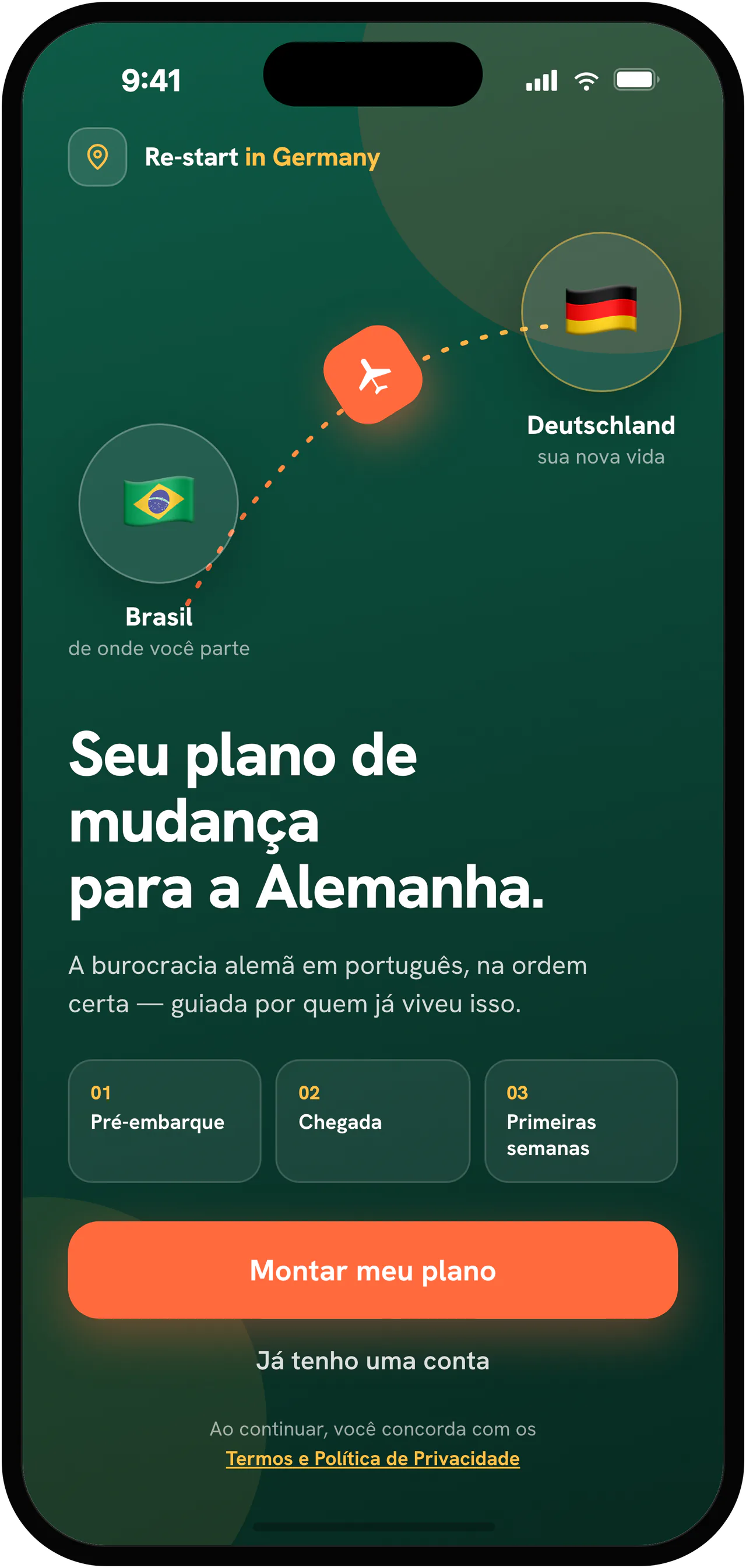
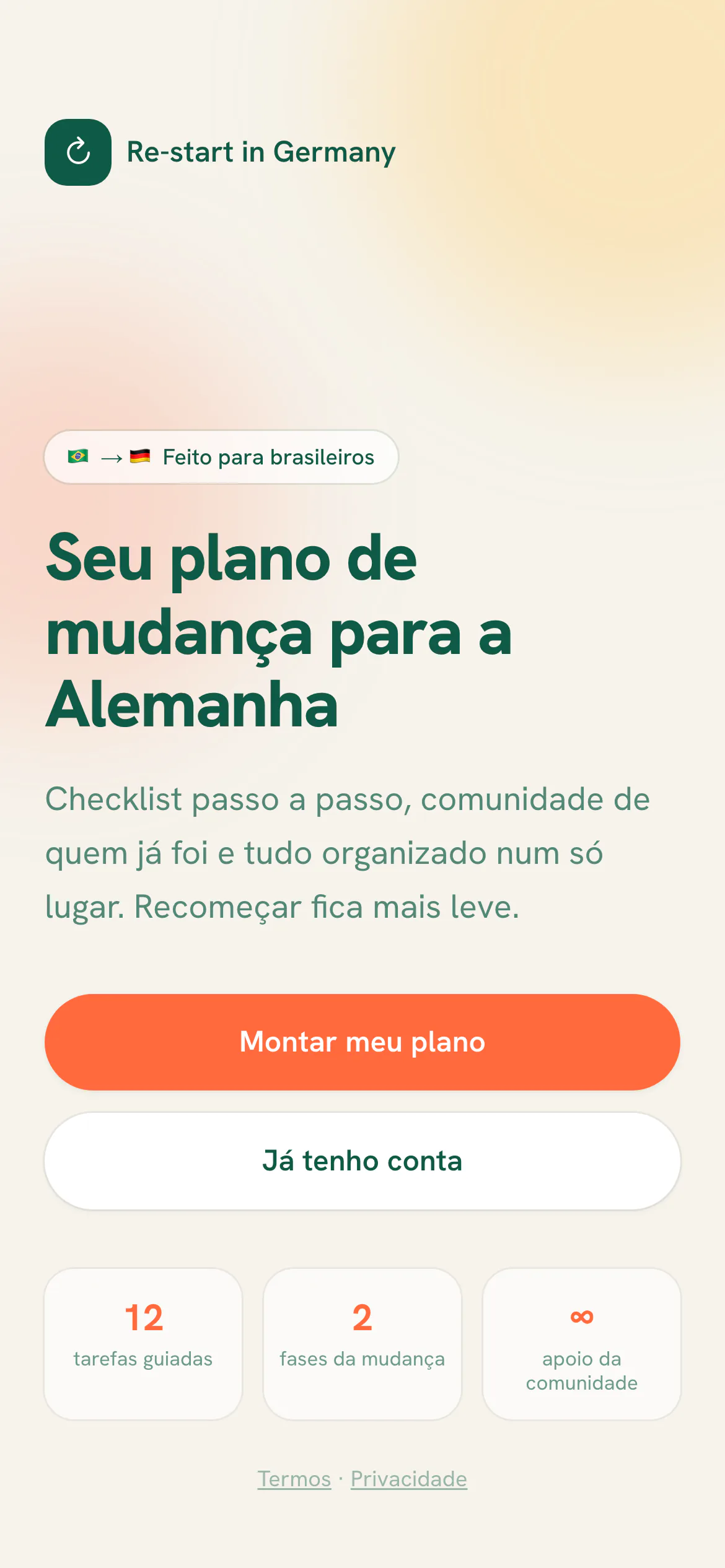
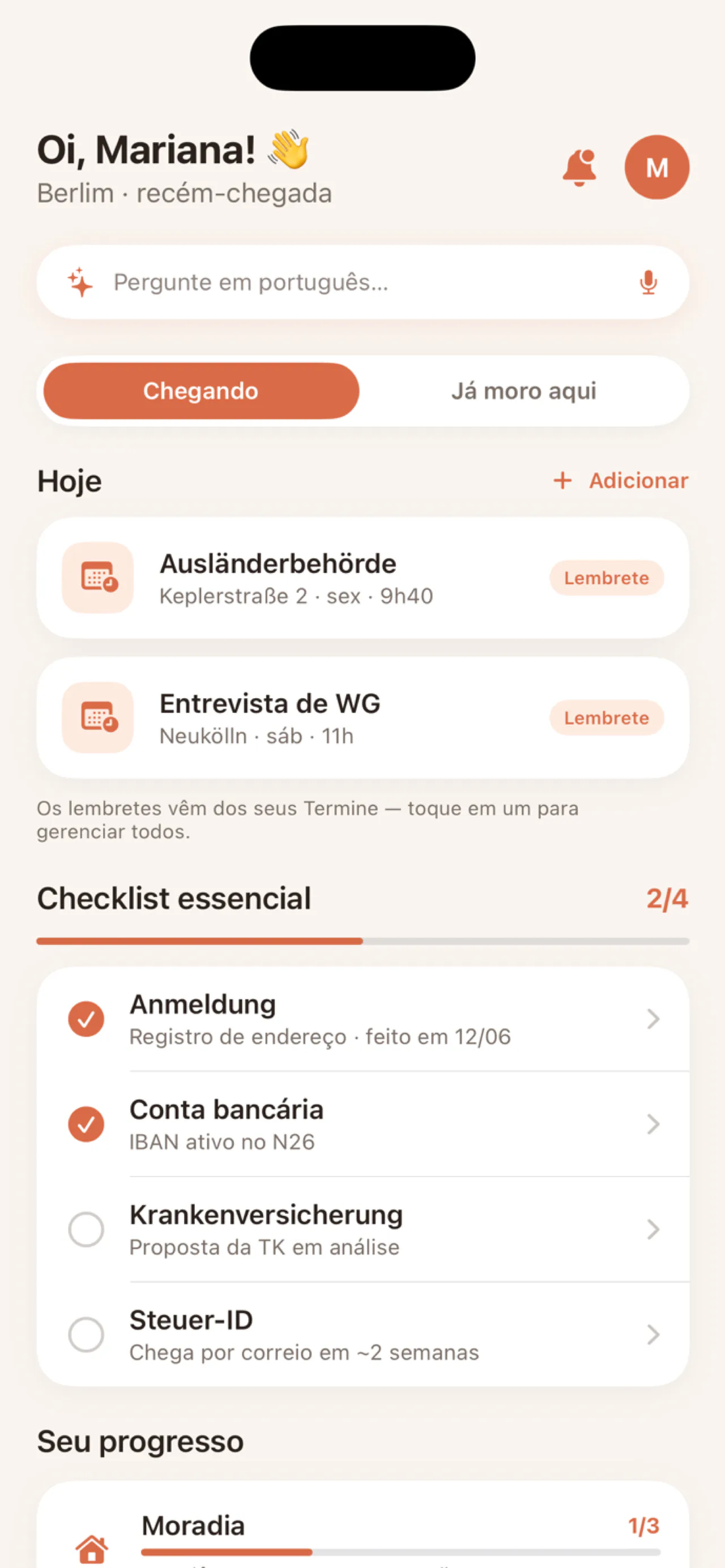
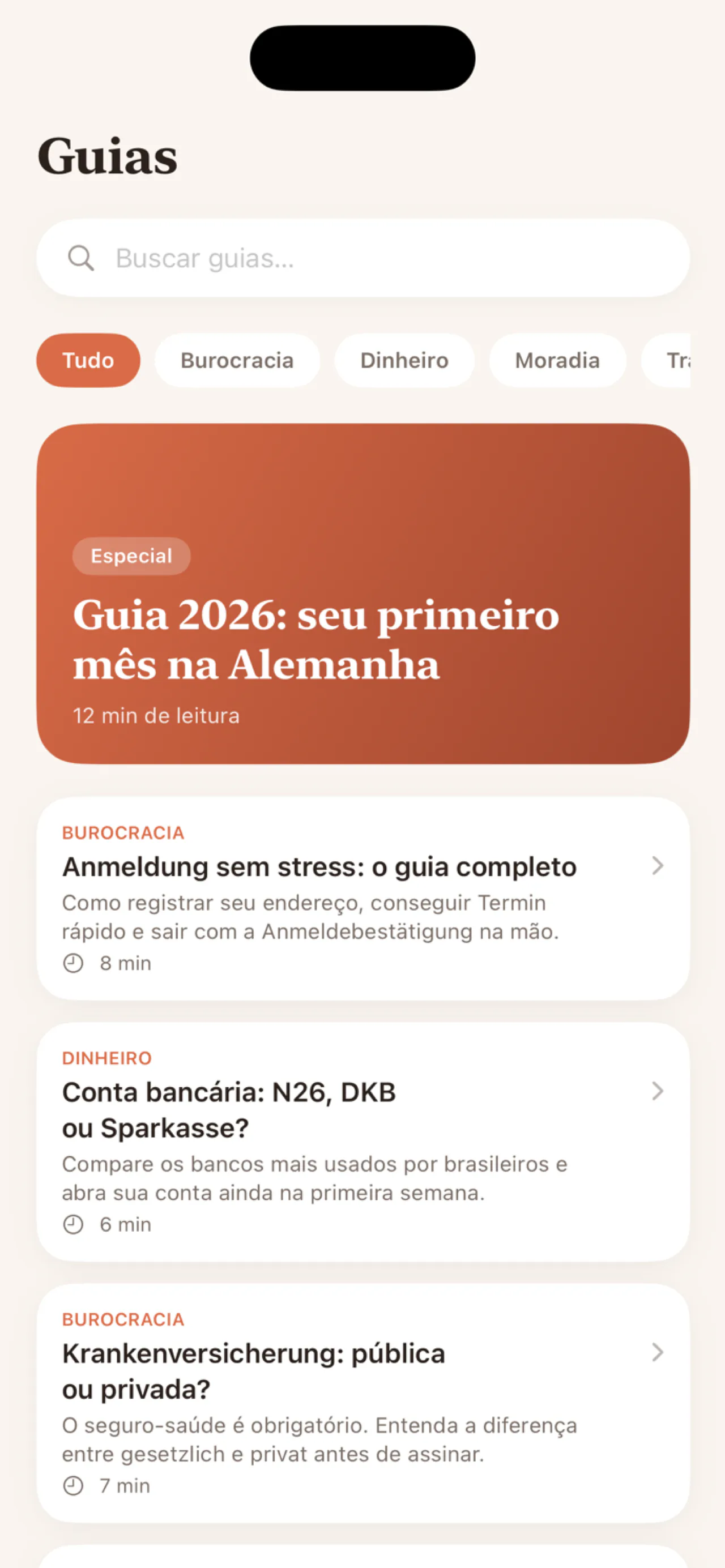
The information architecture is deliberately shallow: four tabs (Início, Guias, Comunidade, Perfil), never more than two levels deep, so an anxious newcomer always knows where they are. Onboarding asks three questions (visa, timing, city) and hands over a personal plan before asking for an account. The signature screen is the bureaucracy map, which keeps each step locked until the step it depends on is done. The circular trap becomes a straight line.
Behind it sits a small design system (color roles, Inter with Newsreader Italic, a 4px spacing grid, three elevation levels), hi-fi screens in Figma and a clickable prototype in Portuguese covering onboarding, the checklist, the map, community, a visa comparison, a cost calculator, templates and the Premium paywall.
Finding → decision
41%found documents and bureaucracy the most stressful part (9 of 22)
Decision 1: The bureaucracy map: each step stays locked until the step it depends on is done.
71%would use an app for its step-by-step checklists (15 of 21)
Decision 2: A journey checklist with a deadline on every task.
55%say a step-by-step guide in Portuguese would give them more confidence (12 of 22)
Decision 3: Portuguese first: the prototype, the web app and the iOS build all speak Portuguese.
73%asked friends already living in Germany (16 of 22)
Decision 4: A peer tone and a real community: Comunidade is one of the four tabs.
Business case
A business, on paper first.
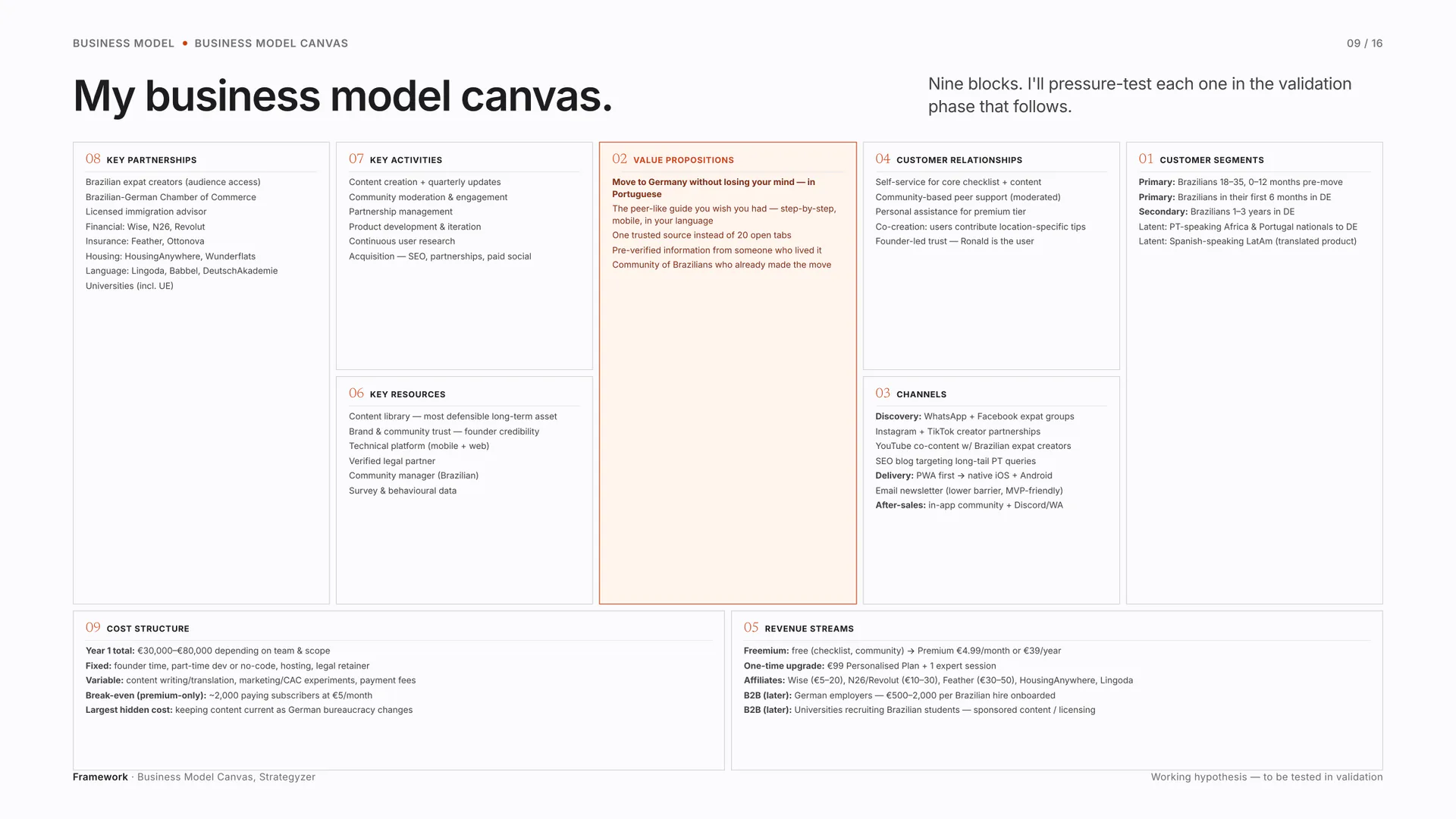
For the Professional Practice course I turned the research into a Value Proposition Canvas and a Business Model Canvas. The model is a freemium hypothesis: core guides free, Premium at €4.99 a month or €39 a year, affiliate partners for early growth, and B2B onboarding for employers kept as a later option.
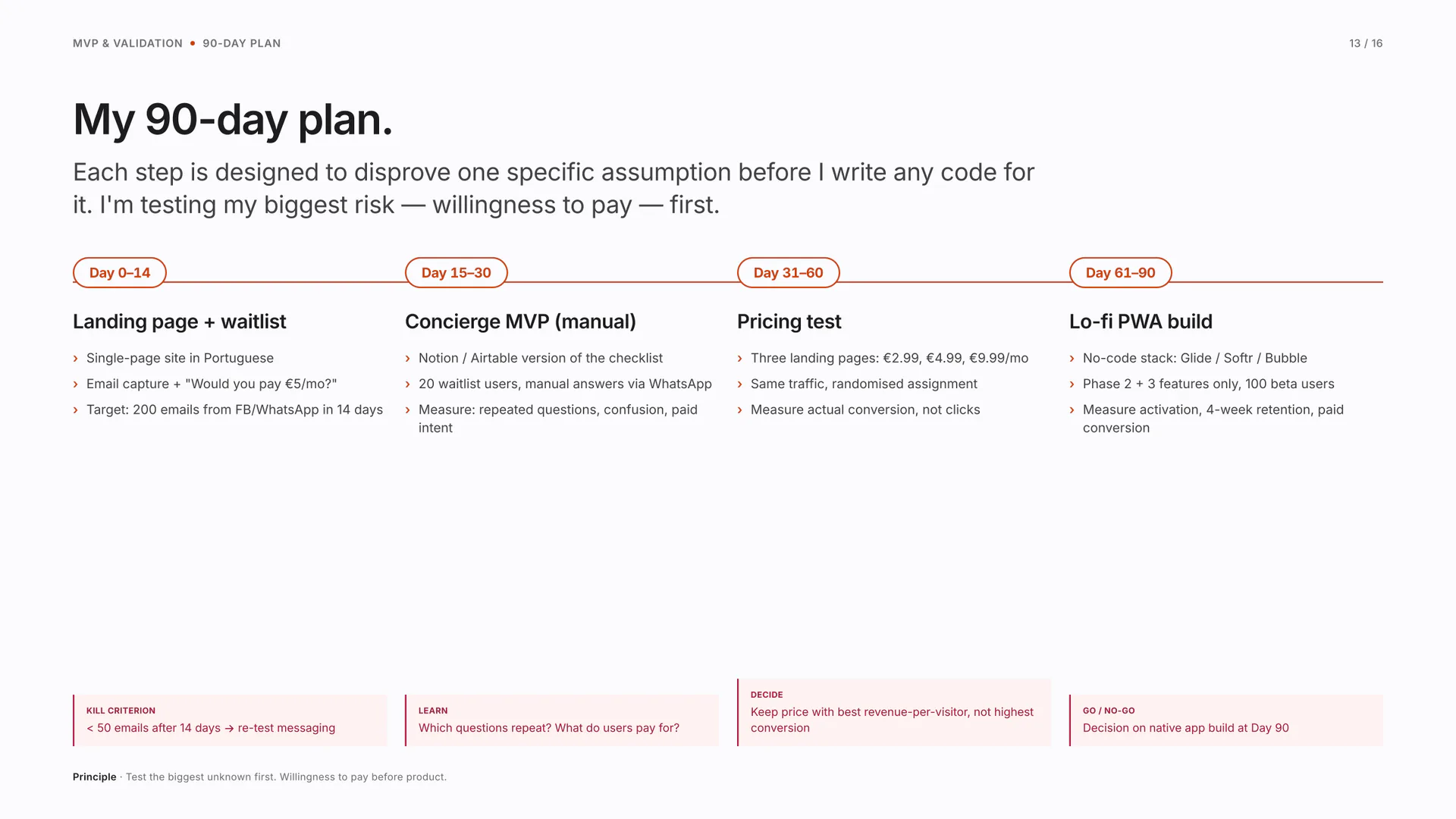
I narrowed the MVP to the two phases where the pain is sharpest, pre-arrival and the first weeks, in Portuguese only and for four cities. Then I wrote a 90-day validation plan with explicit kill criteria. Paid conversion leads the metrics, because stated intent usually overstates real behavior, and four pivots are committed in advance if it stays below 5%. It is a plan. It has not been run.
Waitlist
A Portuguese landing page with a price-sensitivity question.
Concierge MVP
Run the service by hand before building it.
Price test
€2.99, €4.99 and €9.99, side by side.
Lo-fi PWA
Only then, a lightweight app.
Beyond the brief
Then I built it.
The brief ended with a prototype. I kept going. Between 30 June and 3 July 2026 I built a web app with Next.js, Supabase and Netlify: sign-up with email or Google, a personalized onboarding, a checklist that saves progress, a community feed and Premium gating through a payment webhook. It is live. Payments are still in test mode.
From 6 to 14 July I rebuilt it natively in SwiftUI for iOS 26. Data stays on the device by default. It adds on-device Portuguese–German translation, a Face ID document wallet, a scanner that explains German letters in Portuguese, and an Apple Intelligence assistant that points people to the right guide instead of inventing advice.
That native build became the foundation of Brazuka: the research had shown the pain was real, so the next step was a product people could download.
Part 2Product
Brazuka, shipped
The research showed the pain was real, so I kept going: from a native prototype to a community app on two platforms, with real users, a subscription and a weekly report.
Independent product · iOS since 25 Jul 2026 · Android on Google Play since Oct 2026
Product
One app for the whole community.
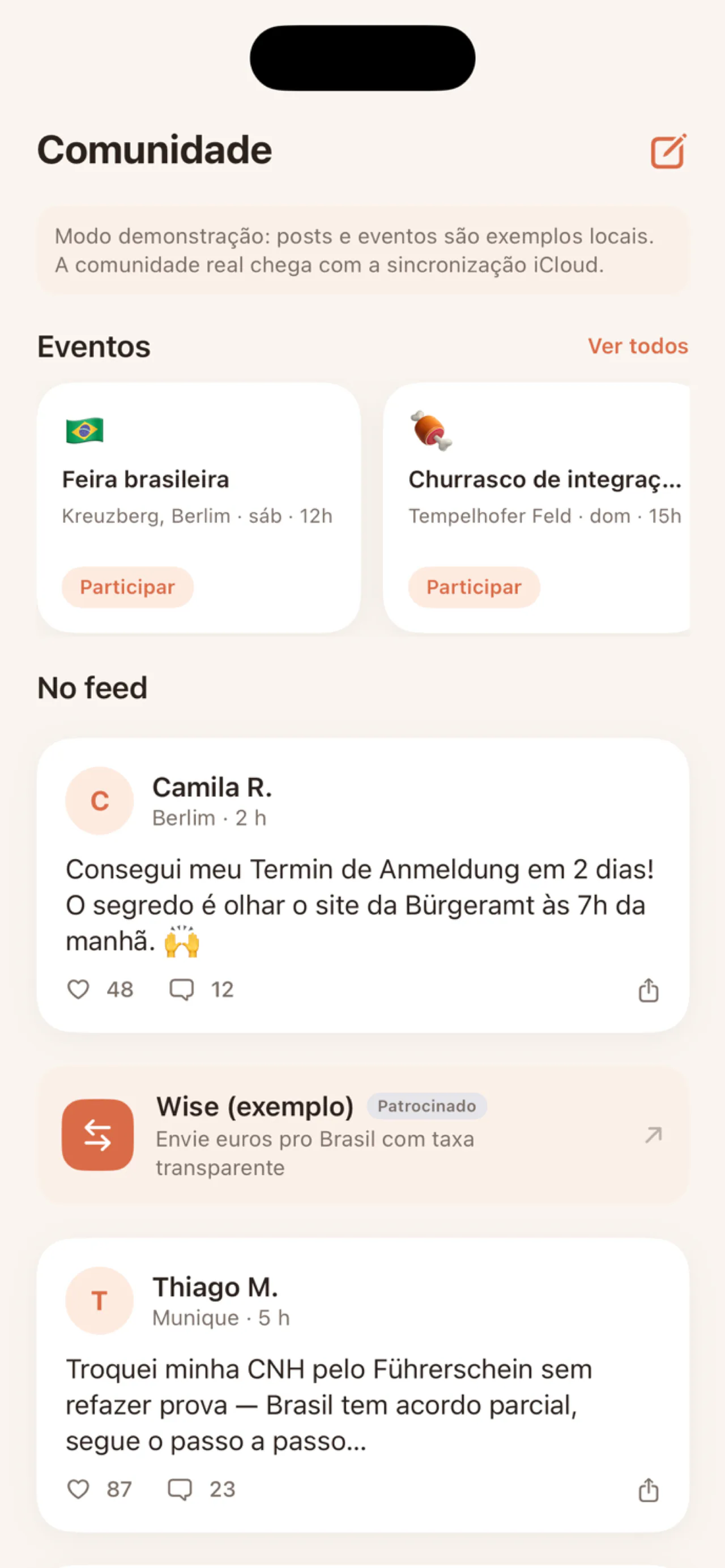
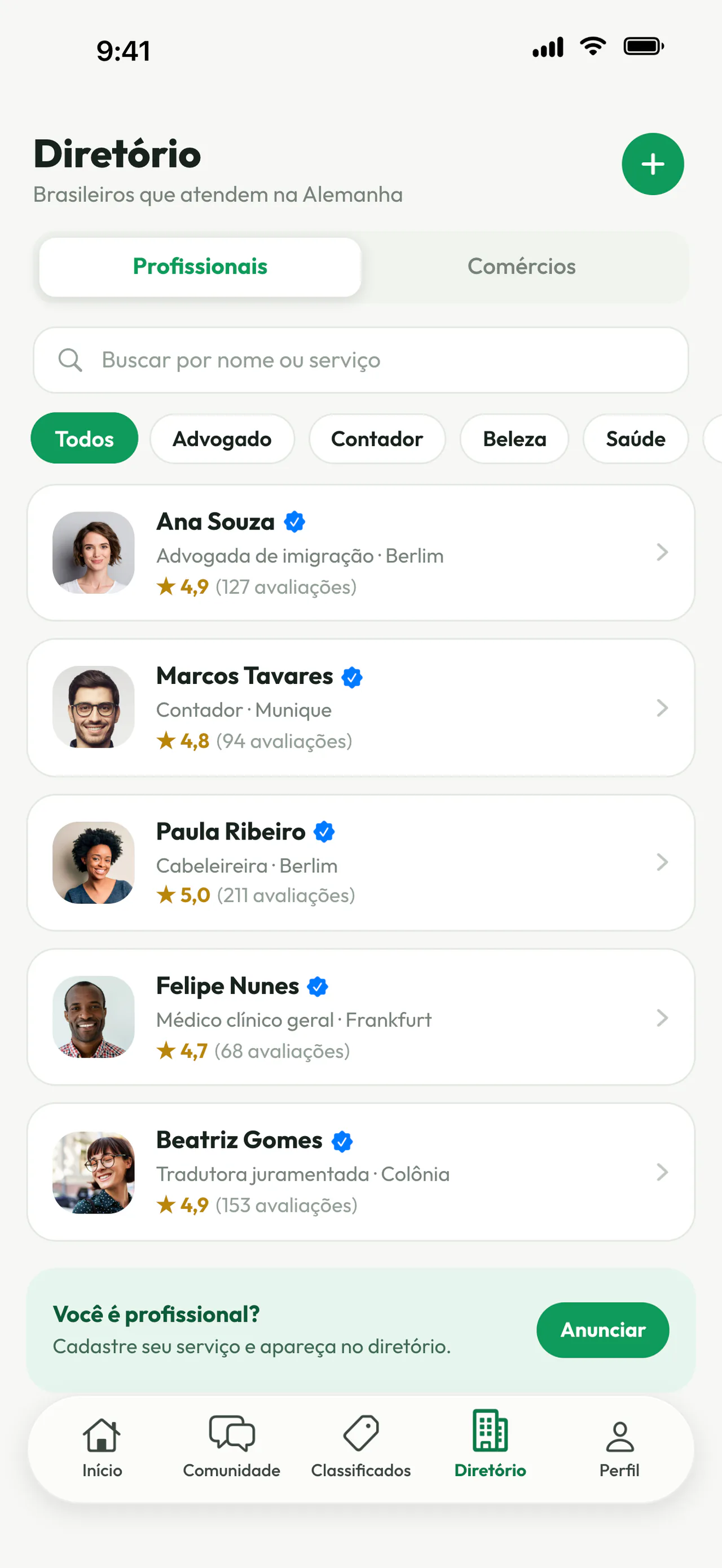
Brazuka puts the pieces in one place. A feed filtered by city and topic. A directory of Portuguese-speaking professionals and Brazilian businesses. Classifieds, events, private chat, and the everyday tools a newcomer needs.
- Community feed with photo posts, comments and five reactions
- Directory with a Professionals / Businesses toggle, verified badges and one-tap contact by WhatsApp, Instagram, website or phone
- Classifieds with direct messages to the seller
- Events with RSVP, comments, add-to-calendar and maps
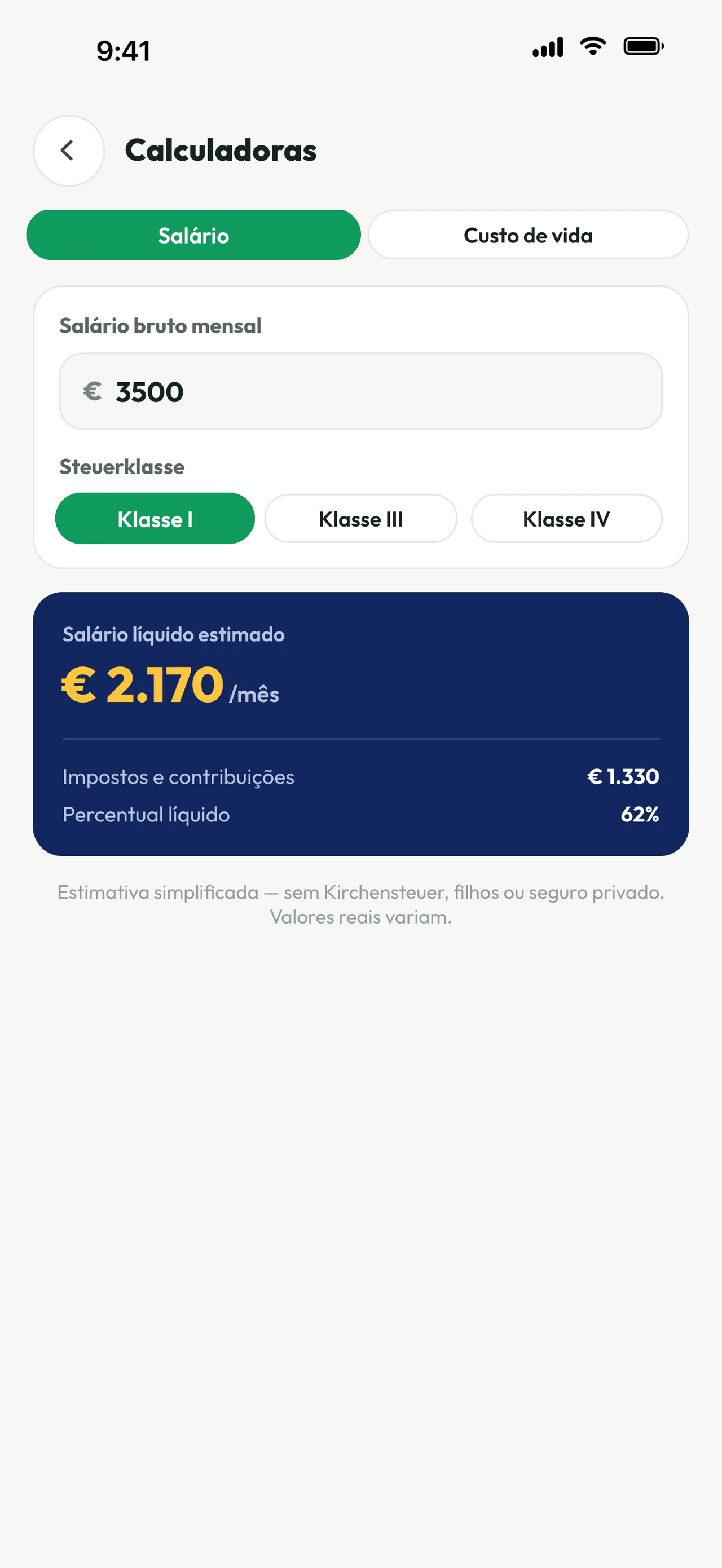
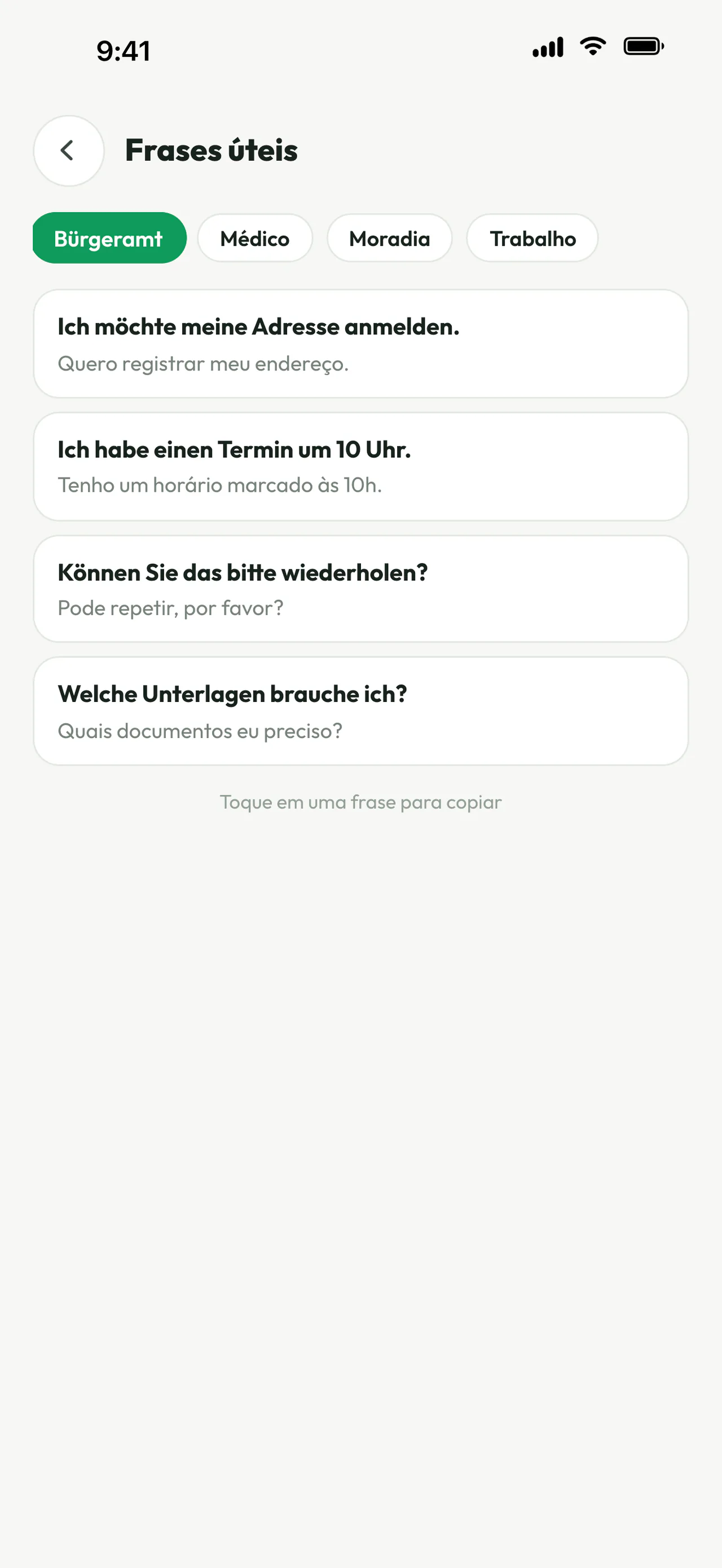
- Gross-to-net salary calculator by tax class, a German phrasebook and a private document vault
- Push notifications, plus reporting, blocking and an admin queue for moderation
Design
Portuguese first, phase aware.
The whole interface speaks Brazilian Portuguese, and the visual language borrows Brazil’s colors without using the flag: deep navy, green and warm yellow on calm surfaces. The icon is a single ribbon that starts in Brazil’s green and yellow and ends as an arrow in Germany’s black, red and gold.
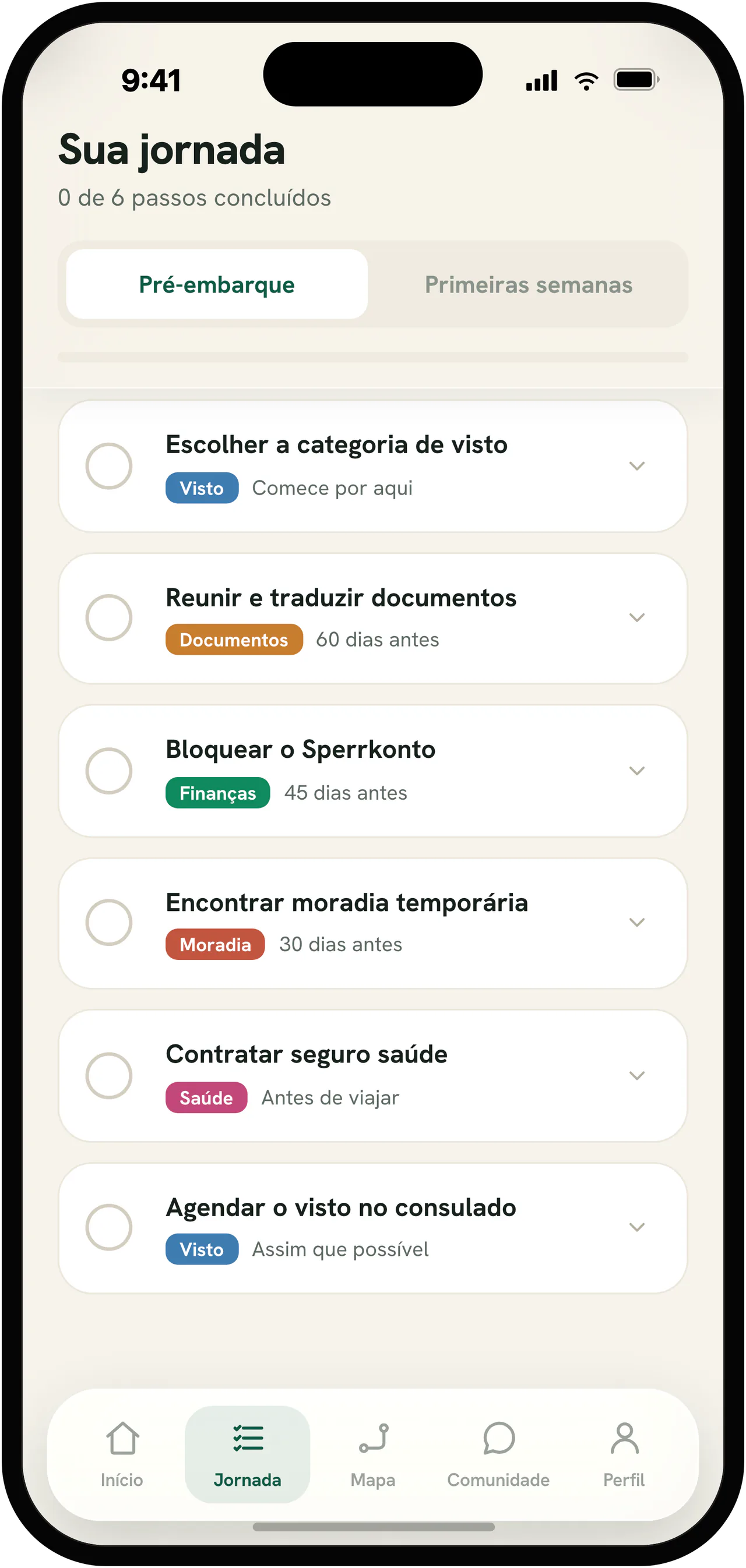
The arrival checklist, called ‘Chegando’, follows where you are in the move. A toggle switches between still in Brazil and already in Germany, tasks are grouped by theme, and your progress earns a badge on your profile. Before writing code I explored the product in a 32-screen product brief and an interactive HTML prototype.
After launch I redesigned the screens that carry the most trust and revenue: the paywall, event detail and professional profile. Dark mode, Dynamic Type and 44 pt touch targets are built in, and state restoration means a half-written listing survives iOS closing the app in the background.
Engineering
Two native apps, one backend.
The iOS app, written in SwiftUI, is the source of truth. The Android app is a deliberate 1:1 port in Kotlin and Jetpack Compose: each screen names the Swift struct it mirrors, spacing and radii are copied rather than reinvented, and a custom continuous-corner shape recreates Apple’s squircles. Where the platforms differ, the swap is an explicit decision. Anyone reading either codebase can trace a screen to its twin, which keeps both apps easy to review and hand over.
Both apps share one Firebase project: Authentication, Firestore, Storage, Cloud Messaging and Crashlytics. Seven Cloud Functions send push notifications, alert admins about reports, clean up past events every night and remove personal data when someone deletes their account. Firestore and Storage rules enforce ownership and field-level edit limits, and every rule change runs against the local emulator before it ships.
Sharing a backend surfaced real cross-platform bugs. Profiles created on Android once failed to decode on iOS because of one missing field. I fixed it in both clients and in production data. Xcode Cloud builds on every push and archives every tagged release, with configuration injected at build time.
- StoreKit 2: one Play Billing product with monthly and yearly base plans
- Sign in with Apple: Google Sign-In via Credential Manager
- APNs: FCM notification channels
- MapKit address search: Google Places SDK
- SwiftData: Jetpack DataStore
Business
Free to join, Pro to go deeper.
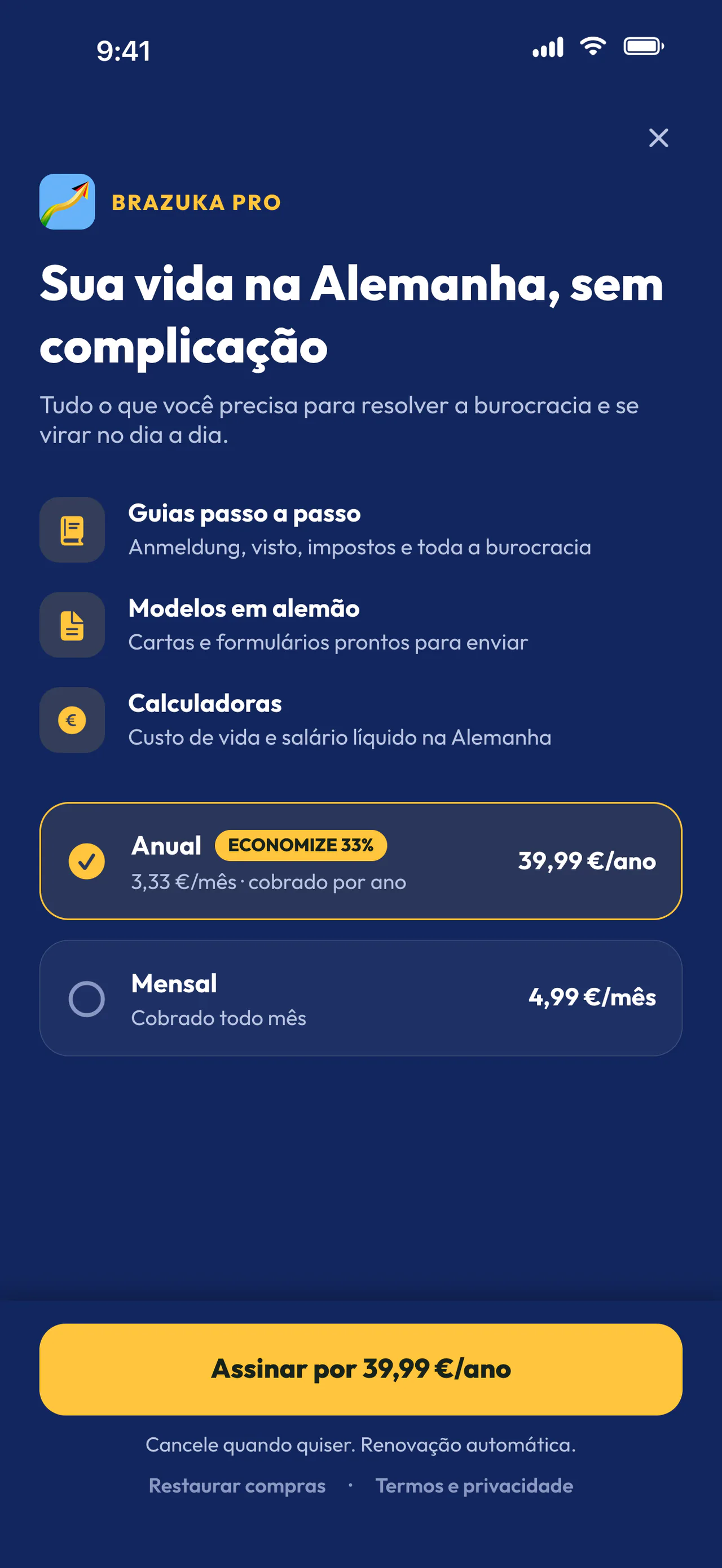
Brazuka is free. Brazuka Pro, at €4.99 a month or €39.99 a year, unlocks the full step-by-step guides (Anmeldung, Steuer-ID, Aufenthaltstitel, bank account, Krankenversicherung), copy-ready German letter templates and a cost-of-living calculator. Contacting professionals, businesses and sellers is free for everyone: the monthly contact limit was dropped in October 2026 because it pushed newcomers away.
On iOS the subscription runs on StoreKit 2. On Android it is one Google Play Billing product with monthly and yearly base plans, so both platforms offer the same subscription.
Launch
Shipped, then measured.
Brazuka went live on the App Store on 25 July 2026. Android requests started in the first week. By week three, most of the engaged leads from my build-in-public posts on Threads were on Android and couldn’t install it. So platform reach became the only priority, and I built a native port rather than a web app. Google Play approved it for closed testing on 15 September 2026, and it went public on Google Play in October 2026.
I track a short weekly report of downloads, users, organic listings and content, and I tag small releases often: four per platform between 28 September and 2 October 2026.
Results
Results: the first 12 weeks
- registered accounts
- 200+
- downloads across iOS and Android
- 220+
- organic growth, no paid ads
- 100%
- iOS releases in the first 7 weeks after launch
- 6
Learned
What I learned
The research channel became the growth channel.
I ran the user research inside WhatsApp groups of Brazilians in Germany. Later, every sign-up spike came from posts in those same groups.
The platform was the bottleneck, not the product.
Many of the people most interested in the app were on Android while it was iOS only. That moved Android up the roadmap, and the Android version went live in October 2026.
Next challenge: turning sign-ups into subscribers.
People find the app and create accounts. The next design step is the path to the Pro plan: where it appears, what it promises and when.
Role
My role
Solo project: research, UX/UI, iOS (SwiftUI), Android (Kotlin/Compose) and Firebase backend, built with AI agents.
Reflection
What I’d test next.
Twenty-two people is a start, not a representative sample. And it has a blind spot: 21 of 22 respondents have lived in Germany for more than a year, so they described the move from memory, and nobody answered from the middle of one. Willingness to pay was stated, not measured.
Next I would recruit a larger group that includes people still in Brazil or in the middle of moving, run usability tests on the Anmeldung flow with them, and measure real paid conversion instead of intent.